
The word “quantum” gets used a lot in the wellness space – often loosely, and sometimes incorrectly.
So before we go any further, let’s be clear about something: this isn’t about using science to “prove” holistic practices. It’s about exploring where modern physics and human experience begin to ask similar questions – particularly when it comes to quantum mechanics and consciousness, connection, awareness and the nature of reality.
To understand this properly, it helps to look at what quantum mechanics actually is, and how scientists currently understand consciousness and the mind–body connection.
What is quantum mechanics, in simple terms?
Quantum mechanics is a branch of physics that studies how reality behaves at the smallest measurable levels – atoms and subatomic particles.
According to CERN, at this level, particles don’t behave in fixed, predictable ways like objects in everyday life.
Particles can exist in multiple states at once, behave as both particles and waves and appear to influence each other across distance. This is often referred to as entanglement.
As explained by the Stanford Encyclopedia of Philosophy, quantum entanglement describes how particles can remain correlated in ways that classical physics cannot explain, even when separated by large distances.
Where it becomes interesting
In everyday life, we experience ourselves as separate – separate from other people, separate from our environment and even separate from parts of our own body. But at a fundamental level, physics suggests that reality is far less intuitive than it appears.
“I think I can safely say that nobody understands quantum mechanics.”
— Richard Feynman
This doesn’t mean anything mystical by default. It simply highlights that reality, at its most fundamental level, does not behave in ways that align with everyday perception.
So where does consciousness fit in?
This is where things become less certain – and more debated. Science has not yet fully explained what consciousness is, where it comes from or how it interacts with the body.
Some perspectives suggest that consciousness is generated by the brain. Others explore the idea that consciousness may be more fundamental.
Neuroscientist Anil Seth, author of Being You, explains that “we don’t just passively perceive the world, we actively generate it.”
There is no single agreed answer, but the question itself is important.
The relationship between neuroscience and consciousness remains one of science’s deepest questions. What we perceive as reality may be shaped as much by our internal state as by external events – suggesting perception is an active, constructive process.
How the mind–body connection shows up in the body
Regardless of where you land on the science, one thing is clear: how thoughts affect the body is measurable. Your thoughts, emotions and perceptions have a direct impact on your physical state.
Stress response
Emotional stress and the nervous system trigger measurable physical changes throughout the body
Placebo effect
Belief and expectation alone can produce real physiological outcomes
Neuroplasticity
The brain continuously restructures itself based on experience and awareness
“The brain is not a static organ, but a living system that can change its own structure.”
— Norman Doidge, The Brain That Changes Itself
So while quantum mechanics operates at a level far removed from everyday biology, it points to a broader idea: that what we experience internally and what happens physically may be more connected than we once believed.
A different way of understanding healing
In conventional models, the body is often treated like a machine: identify the problem, apply the fix, remove the symptom.
But human beings are more complex than that. There are layers – and these layers are constantly interacting.
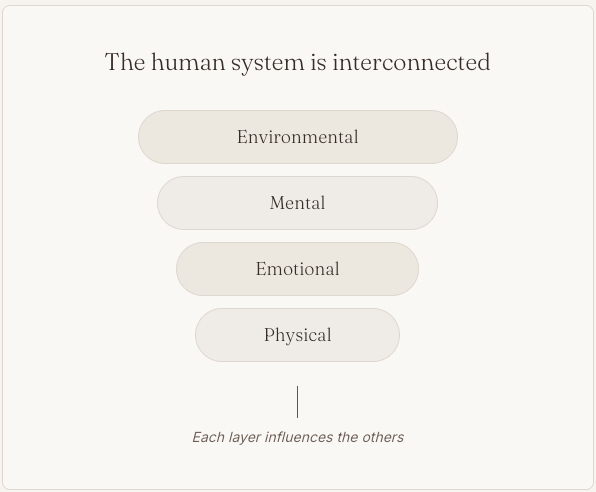
Physicist Fritjof Capra, author of The Tao of Physics, explores this intersection between systems thinking and human experience.
Approaches like BodyTalk work within this complexity – not by isolating parts, but by supporting communication across the whole system. You can explore how this works in more detail on my Services page.
This is not about belief
You don’t need to “believe” in quantum physics for your body to function. And you don’t need to understand it for your nervous system to respond to stress, safety or support.
The value in exploring these ideas is not in having definitive answers. It’s in expanding how we think about connection – within the body, between mind and body and between ourselves and the world around us.
Where intuition fits in
Intuition is often dismissed because it’s not easily measurable. But in practice, it can be understood as a form of awareness:
- Pattern recognition
- Subtle internal signalling
- Rapid processing beyond conscious thought
When used responsibly, it doesn’t replace logic; it complements it.
“The intuitive mind is a sacred gift and the rational mind is a faithful servant.”
— Carl Jung
You’re not separate from the process
One of the biggest shifts people experience in this work is moving from:
Whether you view that through a scientific lens, a holistic lens or a combination of both, the outcome is the same: more awareness, more connection and more ability to respond, rather than react.